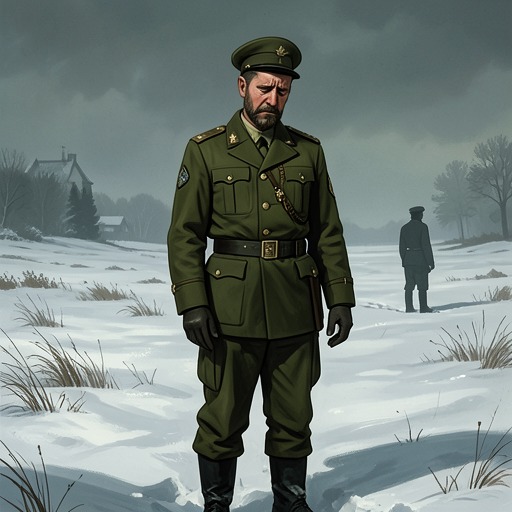
World War II
Operation NapoleonWorld War II is the distant but active force behind the German aircraft on Vatnajökull Glacier: its final stages bring the plane down in Iceland, while the secret operation associated with it grows out of wartime calculations about Europe’s future. In the later investigation, the war returns through fragmentary evidence—a wheel rim, damaged documents, and memories carefully kept for decades—so that the past remains consequential without becoming fully knowable.
The wartime crash and its discovery
During the closing stages of World War II, a German aircraft came down on the glacier in a blizzard. The crash left its fuselage skidding across the ice after an engine caught fire and both wings tore away. Two panicked passengers were thrown against the cabin and died; the surviving account describes the storm closing over the wreck almost as soon as it stopped moving.
The aircraft was not immediately reported. Two local brothers, unable to use a telephone whose lines had been downed in an earlier storm, waited until the weather improved and then travelled by horse to Höfn. The district official passed their report to Reykjavík authorities. Air traffic control at the United States Army base had not detected the aircraft, since severe conditions had kept flights to a minimum.
The United States Army took charge of the investigation and prohibited traffic on the part of the glacier where the plane was believed to have crashed, without offering an explanation. Four days later, a force of two hundred soldiers reached Höfn in twelve transport vehicles. With the local airstrip closed for winter and the rivers across the Skeidará sands unbridged, the expedition had travelled around the country, negotiating snowbound roads and heavy drifts.
The first search and the glacier’s concealment
Colonel Miller led the search, but the first expedition found no aircraft. Its one physical trace was the rim of the nose wheel, which Miller immediately took into his possession. The brothers had found it about two kilometres onto the ice cap; beyond it, the snow-covered surface gave no sign of a crash. They suggested that drifted snow had already covered the wreck. The glacier, in the novel’s account, had swallowed the evidence.
The search was twice interrupted by severe weather. In the second storm, tents and other equipment disappeared beneath the snow, and Miller had to abandon the effort. The brothers remembered his relentless determination and his reliance on their local knowledge. They also remembered seeing him alone in a stable, weeping beside a horse before quickly composing himself. That private moment complicates the young colonel’s public image of courage and authority, but the brothers never learned what it meant.
Wartime calculations and Operation Napoleon
Decades later, Vytautas Carr explains that the aircraft had crashed during the war’s closing period and that an expedition had been sent from Reykjavík soon afterward. He describes Vatnajökull as an immense, moving ice mass whose changing glacial tongues can bury objects and return them much later. The wreck’s reappearance therefore joins a physical process to a political one: what had been hidden by the ice is again exposed, while the reason for the original secrecy remains contested.
Carr places the secret operation in a wider wartime setting. As Germany’s defeat became evident and the Soviet Red Army advanced through Eastern Europe, Allied discussions concerned how Europe would be divided between Allied and Russian occupation. Some people began considering whether to make an armistice with Germany and then attack the Soviet Union; General Patton was the only person Carr identifies as openly raising that proposal, and he says it was not taken seriously. These negotiations provide the political context Carr gives for Operation Napoleon, but not a complete account of its contents or authorship.
The war’s material and political legacies are also linked through Carr’s account of the Walchensee gold. Shortly before the fall of Berlin, more than three hundred small bags, each containing a gold bar, were reportedly sent from the Reichsbank on Adolf Hitler’s personal orders. The shipment was said to have been buried near the Obernach power plant in Walchensee, then dug up by American troops in February 1945 and taken to the United States. Carr presents the story as an allegation that the U.S. government refused to clarify, one that continued to be revived in the German media. It establishes a wartime pattern of disputed transfers and official silence, not proof that the glacier aircraft carried gold.
Memory, secrecy, and the war’s afterlife
The novel’s later witnesses possess different fragments rather than a single authoritative account. A former serviceman recalls rumours that the military was searching for a plane with dangerous cargo and describes regular monitoring flights over Iceland and the sea to its north. Once a month, crews photographed the southeastern section of Vatnajökull; Leo Stiller organized those flights. The witness says he never spotted anything himself, distinguishing what he personally saw from what others believed they had detected.
Sarah Steinkamp supplies another limited but important piece of testimony: she says Leo knew about the aircraft and had told her it belonged to the Nazis. His death in a helicopter accident leaves that knowledge without its original witness. The damaged papers later found in a small metal case offer a different kind of trace. Most of the German typewritten sheets had been ruined by years of alternating heat and cold, but the words Operation Napoleon remained legible in one place.
Colonel Miller’s later recollection further narrows what can be claimed. He says that only a tightly controlled group within the army knew about Operation Napoleon, and that he himself never knew precisely what it involved or what the documents contained. He understood himself and his brother to have been pawns assigned a particular task; his account of the operation’s origins among a handful of American generals is explicitly uncertain. World War II thus remains present as both cause and unresolved record: the aircraft and papers survive in fragments, while the people who might have explained them were restricted by orders, distance, or death.